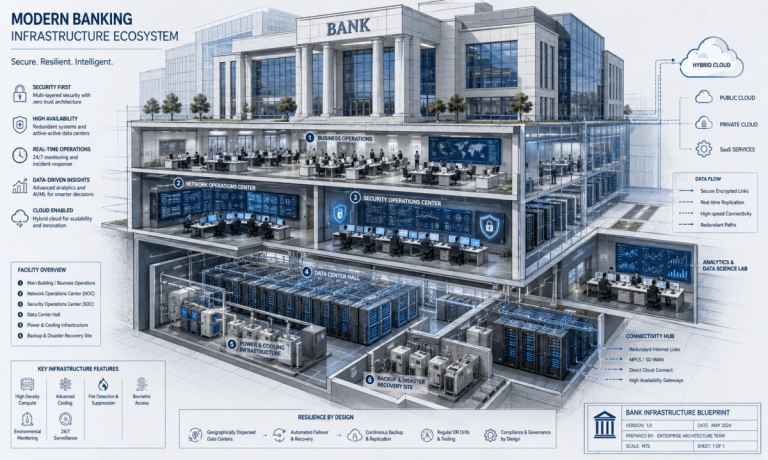
Banks have spent years building the data pipes. This week, the industry confronted what happens when artificial intelligence (AI) agents start running through them: who builds the infrastructure, who sets the rules and who captures the value.
Inside Fiserv’s Bet on a Single AI Operating System for Banks
Banks have spent years running disconnected AI pilots with no common infrastructure underneath them. Fiserv launched agentOS, an operating system designed to let financial institutions deploy and manage AI agents across core banking, payments and servicing workflows from a single governed environment. Six banks helped build it. Two are in beta today. OpenAI and AWS joined as collaborators.
The use cases already in motion are narrow but concrete. First Interstate Bank is piloting an agent for commercial loan onboarding, a process that currently spans multiple systems and requires significant manual hours. Boulder Dam Credit Union is running a daily operational analysis agent that compressed report generation from ten minutes to seconds. Fiserv noted the platform includes kill switches, human-in-the-loop controls and audit trails designed to meet bank-grade regulatory requirements.
Fiserv Co-president Dhivya Suryadevara said that every bank client the company has spoken with is facing the same pressures: cost, deposit competition and a retiring workforce. AgentOS is Fiserv’s answer to all three at once. Whether that answer holds at the scale of thousands of institutions, across systems Fiserv does not control, is what the next 12 months will reveal.
When AI Agents Access Your Bank Account, Who Is Responsible?
The infrastructure is moving faster than the rules. The Financial Data Exchange launched an initiative specifically focused on what happens when AI agents handle consumer financial data autonomously. FDX is a non-profit standards body representing approximately 200 organizations, with more than 114 million customer accounts connected through application programming interfaces (APIs) aligned with its technical standards.
The problem it is trying to solve is structural. When a consumer connects a bank account to a third-party app, the consent is visible and deliberate. When an AI agent does the same thing on a consumer’s behalf, the questions multiply: who authorized the agent, what data can it access, how is that permission tracked and who is liable when something goes wrong. The standards that govern consumer financial data sharing today were not written for that scenario.
Advertisement: Scroll to Continue
FDX CEO Kevin Feltes said that broad industry collaboration will be critical in the months ahead to ensure connections are built in a way that protects consumers. The call for input is open through May 29. The answers will shape what banks and FinTechs can actually deploy and how much regulatory exposure they carry when they do.
Banks Spent a Decade on Data Infrastructure. Now Comes the Hard Part.
The backdrop for both announcements comes from an analysis Camunda published, drawing on research from Datos Insights. The argument is direct: financial institutions spent a decade building data infrastructure: APIs, consent frameworks, secure sharing protocols. Agentic AI is now the layer that can act on that infrastructure rather than simply move data through it.
Many banks treated that infrastructure build as a compliance exercise, Datos Insights found. They built the APIs and stopped. Data flows, but very little happens with it. Agentic AI changes the calculus: an agent can reason across multiple systems, sequence a set of actions and execute a transaction without waiting for a human to initiate each step.
The open question the analysis does not resolve is who captures the value. Banks that built data infrastructure but never activated it have a window now. So do the FinTechs that have been working with that data for years. AgentOS is one answer to how institutions get there. FDX is working out what the guardrails look like when they do. Neither question has a settled answer yet.