Side hustles have moved from optional income enhancers to a routine feature of household financial management, reflecting a labor market where steady pay is no longer assured.
That shift is documented in a recent PYMNTS Intelligence collaboration with Ingo Payments and WorkWhile. The report traces how roughly 60 million Americans in what we define as the Labor Economy are navigating a widening gap between employment stability and financial certainty.
While job security perceptions have improved, confidence in household finances has not followed, suggesting that income reliability rather than employment status is now the central pressure point.
At the core of that tension is the growing prevalence of income interruptions. Over the past year, 22.7% of Labor Economy workers reported a sudden stop in a household income source, compared with 15.1% of higher-earning, salaried workers.
These disruptions are not abstract risks. They stem from tangible constraints such as losing access to a vehicle or essential equipment, cited by 19.9% of affected workers, as well as illness, caregiving demands and seasonal slowdowns in available work.
Fragmented Earnings
The result is a pattern of employment that appears stable on paper yet produces fragmented and unpredictable earnings in practice.
Advertisement: Scroll to Continue
The exposure to these interruptions is not evenly distributed. Workers earning $50,000 or less annually, typically paid hourly and concentrated in logistics, retail, hospitality and service roles, face the highest degree of volatility.
These individuals form more than one-third of the U.S. workforce and account for a meaningful share of consumer spending, yet their incomes are more susceptible to operational disruptions and timing gaps. By contrast, higher-income workers are more likely to encounter income fluctuations tied to demand cycles rather than the sudden loss of work-enabling tools or access.
Bridging Pay Gaps With Side Work
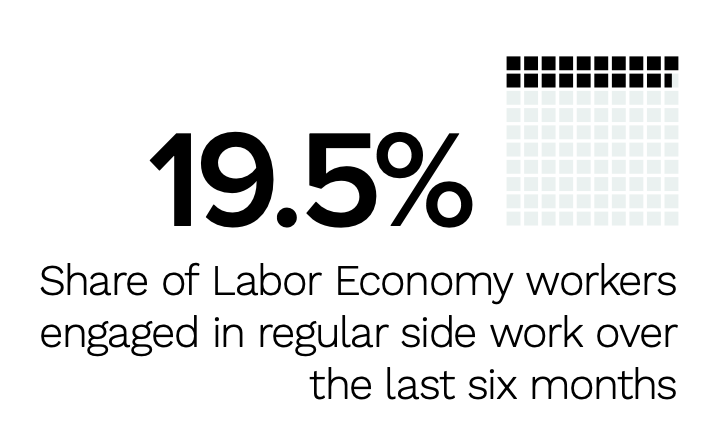
Side work has become the primary response mechanism. Nearly 1 in 5 Labor Economy workers reported performing regular side work in the past six months, a slightly higher share than among higher earners.
However, the nature of that work differs markedly. Lower-income workers tend to rely on task-based, local and platform-driven activities such as delivery services or community-based labor, while higher-income individuals are better positioned to monetize specialized skills through consulting, freelance work or teaching.
These differences extend to how workers react to income interruptions. For Labor Economy households, side hustles are not primarily about advancing financial goals. They are used to stabilize day-to-day living. The report shows that 41.4% of these workers rely on side income to cover basic expenses, compared with 25.3% of higher earners. In effect, side work serves as a bridge between disrupted paychecks rather than a pathway to wealth accumulation.
This dynamic introduces a further complication. While side hustles increase total income, they also contribute to irregular payment timing.
Among established side workers, 46.3% of Labor Economy participants increased their activity in recent months, resulting in income that arrives in uneven bursts rather than predictable intervals. That pattern complicates budgeting and bill management, reinforcing financial stress even when overall earnings rise.
The scale of supplementation varies, but the structure is consistent. Workers typically juggle multiple income streams, averaging just over two side activities per month. This diversification offers some resilience but also underscores the absence of a single reliable source of income. When one stream stops, others must expand quickly to compensate, often at lower pay rates or with less certainty.