Every company says AI is a priority. Budgets are going up. Executive buy-in is strong. So why does scaling feel so hard for so many organizations?
Because the barrier to artificial intelligence isn’t the technology. It’s the operational infrastructure underneath it.
New research from PYMNTS Intelligence shows that financial services, healthcare and media and advertising companies face very different obstacles to deploying AI at scale. And while ambition is shared across all three sectors, what’s blocking progress is unique to each one.
What the Data Shows
AI budget growth is real across the board. Eighty-five percent of financial services and insurance firms plan to increase AI spending over the next 12 months. Media and advertising companies are close behind at 80%. Healthcare trails at 60%, though for reasons the data quickly explains.
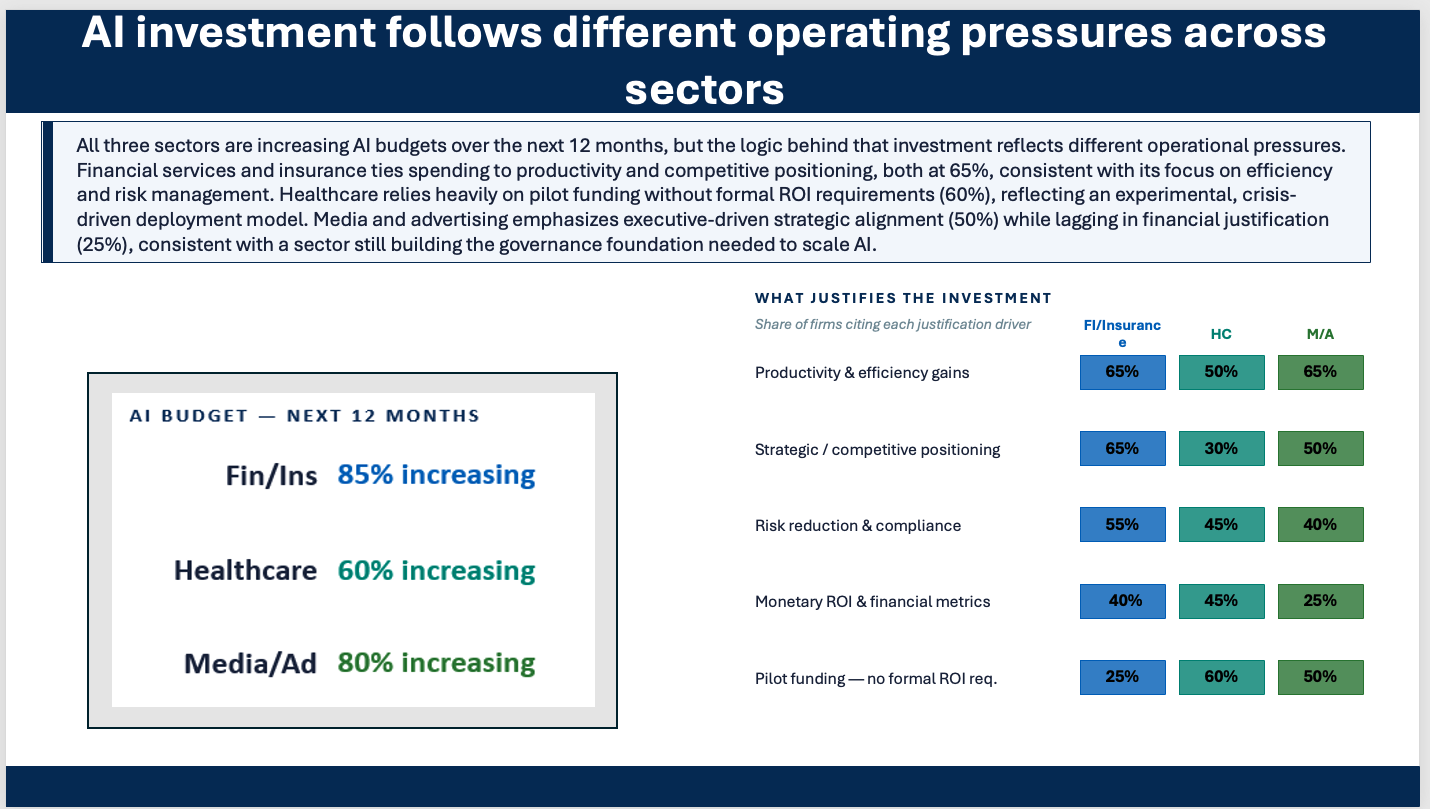
The reasons behind that spending reveal just as much. Financial services firms tie their investment to productivity gains and competitive positioning, both at 65%. Healthcare, by contrast, leans heavily on pilot funding with no formal ROI requirements, cited by 60% of firms. That’s not a sign of lower commitment. It’s a sign of an industry still figuring out where artificial intelligence fits in clinical and operational workflows. Media and advertising points to executive-driven strategic alignment, at 50%, but only 25% of firms in that sector can point to hard financial metrics to justify the spend.
The barriers follow a similar pattern. Financial services firms are held back mainly by data quality problems, cited by 30% as the single biggest obstacle. Clean, standardized data is the foundation for nearly every AI use case in that sector, and too much of it still isn’t there. Healthcare faces two equally serious problems at the same time: system integration and data quality are each cited by 30% of firms. That double constraint is what makes AI so difficult to scale in clinical environments, where patient data lives in dozens of disconnected systems. Media and advertising has no single dominant barrier. Instead, organizational problems spread across skills gaps, governance and leadership alignment are each cited at 15% to 20%.
Advertisement: Scroll to Continue
3 Key Findings
- Financial services has the most mature AI infrastructure of the three sectors, but data quality is the ceiling. The systems are largely in place. The inputs aren’t reliable enough yet to support broader use cases.
- Healthcare’s challenge is structural, not philosophical. Clinical data exists in abundance. The problem is that it is fragmented across systems that don’t talk to each other. AI cannot do much when it can’t reliably access consistent data.
- Media and advertising needs organizational alignment before it can scale anything. Governance, talent and leadership issues must be resolved together. Fixing one without the others doesn’t move the needle.
What This Means for Banking, FinTech and Digital Economy Leaders
For banks and FinTech firms, the data is both encouraging and instructive. Financial services leads in deployment depth and budget commitment. But productivity gains will plateau if data quality problems aren’t addressed directly. That means investing not just in AI tools, but in the data pipelines, governance standards and infrastructure that feed them.
For FinTechs building products for healthcare clients, the integration constraint is a market opening. Solutions that connect fragmented clinical and operational systems are in direct demand.
The Bottom Line
Across all three sectors, more than 80% of leaders say artificial intelligence will augment human decision-making over the next five years, not replace it. The goal is widely shared. The path to it is not. What separates AI leaders from laggards isn’t budget or ambition. It’s whether the operational foundation exists to support the tools they’re buying.